Rakesh Jhunjhunwala-The Rare(ing) Bull


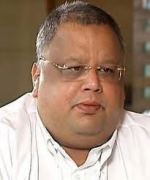
wealthymatters.comRakesh Radheysham Jhunjhunwala is a famous Indian stock investor.He lives in Malabar Hills with his wife Rekha ,daughter Nishtha and twin sons Aryaman and Aryaveer and works from his office at Nariman Point in South Mumbai. He regularly appears on various business channels on television to share his ideas and opinions on the Indian markets. He is well-known in investing circles as ‘Rocky’ and among his close associates as ‘Bhaiyya’.He is considered to be India’s Warren Buffett. In 2010, Forbes rated him India’s 51st and the world’s 1062nd richest man with a net worth  of $1.0 billion.He is the first dollar billionaire from India to have made his fortune primarily from the stock markets.

He considers Mr Radhakrishnan Damani as his guru (mentor) and best friend.He counts Kamal Babu, Ramesh Damani and Kamal Kabra as friends.He manages his own portfolio as a partner in his asset management firm, Rare Enterprises (Ra-Rakesh Jhunjhunwala, Re- Rekha Jhunjhunwala).“The sheer passion for markets and the ability to do what I enjoy is what inspires me,” says Jhunjhunwala. He has been asked to manage other people’s money, but prefers the freedom of not having to answer to anybody, and has thus turned all offers down.Rakesh does not try to beat the market as opposed to investment managers who have to answer to a lot of people, and hence look at indicators like how much alpha — or returns in excess of the general market — they are generating. “The only person that I have to answer to is my wife, and she just wants to know what the absolute returns are, not whether I am beating the market”. He expects the market to do very well as he believes that India is at the beginning of an unprecedented multi-decade bull run.Obviously he believes in putting his money where his mouth is as he owns only Indian equities.There are 7-8 stocks that make up 80% of his portfolio, and his holding period stretches from 3 years to 10. Read more of this post

The Importance of Having a Contingency Fund


wealthymatters.com

This letter was written in 1939,ten years into the Great Depression, by Warren Buffett’s grandfather Ernest, to his youngest son (and Warren Buffett’s uncle) Fred, and his wife. Warren found it in a safe in 1970 while executing a will of a family member…along with $1000. I believe I will gift a copy of this letter and cash for a contingency fund to any children I might have.

Dear Fred & Catherine,

Over a period of a good many years I have known a great many people who at some time or another have suffered in various ways simply because they did not have ready cash. I have known people who have had to sacrifice some of their holdings in order to have money that was necessary to have at that time.

For a good many years your grandfather kept a certain amount of money where he could put his hands on it in very short notice.

For a number of years I have made it a point to keep a reserve, should some occasion come where I would need money quickly, without disturbing the money that I have in my business. There have been a couple of occasions when I found it very convenient to go to this fund. Read more of this post

Buffett Family Philanthropy


Here is an article I came across by chance today.I think it’s worth sharing.

Daddy Givebucks: Lessons Learned When Warren Buffett Hands You $1 Billion

By: Jeff Bailey September 1, 2009

wealthymatters.com

Three years ago, Warren Buffett gave each of his kids $1 billion to give away — suddenly thrusting them into the philanthropic elite. Here’s what they learned.

wealthymatters.com

For all the talk of how Warren Buffett is a normal, aw-shucks Midwestern guy, we know he is not just like us. We don’t play bridge with Bill Gates. We may get calls asking for capital infusions, but they’re from our kids, not from GE and Goldman. And these days, we certainly don’t get 10% dividends on our stocks.

But ask Buffett about his kids — Susie, 56, an Omaha knitting-shop owner; Howie, 54, an Illinois farmer; and Peter, 51, a New York-based new-age musician — and he turns into your typical, gushing dad. “All three are smart. They have good judgment,” he says. “They’re just very decent human beings.”

So decent, he thinks, that three years ago, when he pledged $30 billion in Class B Berkshire Hathaway stock to the Bill & Melinda Gates Foundation, he also promised each of his children $1 billion in shares for their charitable foundations. (All four foundations are receiving their stock grants in annual installments, with the remainder to be paid out upon his death.) Read more of this post

Buffett’s 7 Filters


wealthymatters.com

Anybody who has read anything about Warren Buffett knows he is superbly wealthy and has made all his money through his investment in stocks,that he is a value investor,that his favourite holding period is forever and that he loves his companies to have ‘big moats’.Following are a list of parameters that Buffett uses to evaluate companies.They are from the book ‘The Guru Investor’ by John P. Reese.Why not use these parameters to check out a company before buying its shares?

 STABILITY OF EARNINGS:This can be checked by considering the earnings per share (EPS) for the past 10 years. EPS is derived from the residual profit left after payment of all expenses, taxes, depreciation, interest, preference dividends and belongs entirely to equity shareholders. A company should not have a negative EPS in the past 10 years. If the EPS is lower than that in the previous year, the dip should not be more than 45%.

DEBT TO EARNINGS RATIO: The second variable is the level of long-term debt to earnings ratio. Buffett likes conservatively financed companies. He prefers the long-term debt of a company to have been paid off from its net earnings in less than five years. This implies that the long-term debt to earnings ratio should be less than or equal to five.

RETURN ON EQUITY (ROE): The third variable measures how much money a company earns on its equity. The ratio is generally expressed as a percentage. For a company to figure on Buffett’s radar, its 10-year average ROE should be greater than or equal to 15%. Read more of this post

Indian Philanthropy


wealthymatters.comHere are some major features of Indian Philanthropy as enumerated by eminent Indian businesspeople.They are perspectives that were articulated in response to the Gates-Buffett ‘the Giving Pledge’

1.”India has a very old culture of giving, since the time of Buddha. The concept of philanthropy is not new to us.”—-Rahul Bajaj, chairman, Bajaj Group.

2.”Philanthropy in the first world and in the third world are two different things. In the first world people donate to build a baseball stadium. In India, we have to decide for ourselves what we want out of philanthropy. It is not for the Americans to tell us.”

“shareholders have done more charity than Gates and Buffett put together. How? By allowing Cipla to export drugs for $100 million to Africa, which could have fetched $4 billion if they were exported to the US”—-Yusuf Hamied, chairman & managing director, Cipla Read more of this post