Life-Style Design
December 28, 2012 Leave a comment
 Timothy Ferriss ,an entrepreneur and angel investor,in his bestseller The 4-Hour Workweek: Escape 9-5, Live Anywhere, and Join the New Rich talks about “lifestyle design”.He repudiates the traditional “deferred” life plan in which people work grueling hours and take few vacations for decades and save money in order to relax after retirement.He advocates mini retirements instead.His ideas make sense because the present is our only reality.While it is great to provide for the future, what about those of us who will not be round in the future or might not be as fit and able tomorrow to do the things we really want?Also happiness is as transitory as time and neither can be saved up for the future.
He advocates the acronym DEAL .It stands for Definition, Elimination, Automation, and Liberation.
Definition means figuring out what you want, getting over your fears, seeing past society’s “expectations”, and figuring out what it will really cost to get where a person wants to go.And he shows us how it doesn’t cost so much to have and do the the things we want as long as we think flexibly.As he puts it:The rules of reality can be bent. It just requires thinking in different terms. Read more of this post

 Robert Frank’s new book “High-Beta Rich-How The Manic Wealthy Will Take Us To The Next Boom,Bubble And Bust” is based on interviews with more than 100 people with net worths (or former net worths) of $10m or more. These include the Blixseth family, former billionaires who had to lay off all 110 staff in their enormous residence; the Siegels, who had to abandon the largest private house in the US before it was completed; and Jack Warner, who built a fortune from various business, but ended up a penniless handyman.It is also a tale of how the financial crash of 2008 has affected the US more generally. It includes numerous unemployed former butlers, unoccupied mansions and falling tax revenue for fiscally-pressed state governments. In addition, Frank tells the story of upmarket repo men who specialise in repossessing planes, yachts and the like from indebted millionaires.So basically Frank revisits the lives of the people he profiled in Richistan, and follows up on what has happened to them in the years since he wrote the book in 2006. By 2011, some of these rich people have since gone from riches to rags, or merely to less affluence. His follow up on the people whose jobs it was to serve the needs of the rich shows how many of them are now finding it hard to secure stable jobs from the rich since the 2008 .Since the book with vivid sketches of how the rich, and the formerly rich, really live is a sequel to Richistan, published in 2007, in which he profiled the lives of the rich before the recent financial bust, do read it before starting on this one.
 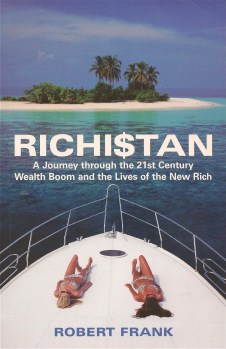 “Richistan: A Journey Through The 21st Century Wealth Boom and the Lives of the New Rich” is a book by Robert Frank who writes “The Wealth Report,” a Wall Street Journal weekly column and blog.The book is an eye-opening, educational and at times amusing summary of Frank’s years of analysis of the “new rich”.They came to his attention in 2003 when he noticed that statistics from the Federal Reserve Board showed a curious pattern: the number of millionaire households in the U.S. had doubled since 1995 and showed no sign of slowing.






 wealthymatters