The Ten Baggers Of Dalal Street
August 19, 2014 Leave a comment
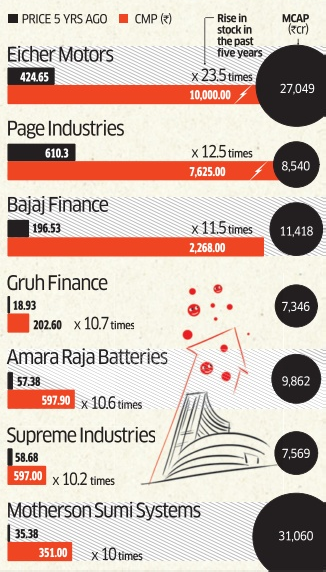 Even the subdued markets of the last five years have produced multibaggers.
For Whom Wealth Matters
August 19, 2014 Leave a comment
Even the subdued markets of the last five years have produced multibaggers.
August 19, 2014 Leave a comment
 The Superinvestors of Graham-and-Doddsville is a seminal essay by Warren Buffett.
Buffett begins this essay by imagining a nationwide coin-flipping contest. Everyone in the US participates and calls the flip of a coin. Call correctly and move on to the next round, guess wrong and you’re out.After 20 days, about 215 lucky flippers will have correctly called 20 consecutive flips. They gloat about their success, yet the nature of coin-flipping tells us they’re just lucky. It’s a game of random chance.
But what if all 215 flippers lived in the same town? What if they all hailed from the same school? The same fraternity? Then we’d get excited. The laws of probability suggest 215 winners after 20 days. But those same laws tell us that if all 215 belonged to an associated group, that almost certainly wouldn’t be the product of random chance. These 215 flippers clearly would know something we don’t.
The real flippers in Buffett speech are nine “superinvestors” — himself included. All nine crushed the market averages over multiyear periods by between 8% and 22% per year.In a world with millions of investors, such returns can occur by sheer luck — just like the 215 coin-flippers appeared at first glance. But all nine superinvestors hailed from the investment school of Benjamin Graham and David Dodd — Columbia professors now known as the fathers of value investing. That meant something big. It meant that their success wasn’t the product of luck. It almost had to be attributable to the only common link they shared: the investing philosophy learned from Graham and Dodd. The “intellectual origin,” as Buffett put it. Read more of this post
August 18, 2014 Leave a comment
 Sometimes free stock advice is expensive. In the past, brokerage houses have come up with buy reports to help their larger clients offload a position and many brokerages release technical trading reports only to help generate brokerage income.
Equity investors who believe in buying stocks only after a thorough research and cannot access company managements on their own often seek independent research . Subscribing to fundamental reports makes economic sense if a family has a direct equities portfolio or is keen to build a portfolio of Rs 8-10 lakh at least. Equitymaster provides long-term stock recommendation services based on fundamental research. The service could cost anywhere between Rs2,000 and Rs30,000 annually. In their Hidden Treasure package, they recommend one small-cap multi-bagger every month. Also, they tell you when to book profit or exit the stock. Then there are individual-led firms like Kolkata-based Basant Maheshwari Financial Services, which gives stock ideas and access to archives of 8,000 questions across stocks which have been answered over the last decade. Read more of this post
August 17, 2014 Leave a comment
 Bill Gates recently revealed that his favourite business book is Business Adventures, a 1969 collection of New Yorker articles by John Brooks that illustrate the formation of the modern American corporation. Here are some of its key lessons that are still applicable today:
Innovators need to keep innovating
Gates writes that one of the most instructive stories in the book is the article, “Xerox Xerox Xerox Xerox.” After the Xerox 914 hit the mass market in 1960, “xeroxing” a document soon became office parlance. Five years later, Xerox brought in $500 million in revenue. Move a few years into the future, Xerox’s leadership became comfortable resting on its laurels. This attitude would eventually lead to huge losses in the late 1970s as competitors started releasing their own photocopiers. But because Xerox executives didn’t think these ideas fit their core business, they chose not to turn them into marketable products. Others stepped in and went to market with products based on the research that Xerox had done. Gates says, “I’m not alone in seeing this decision as a mistake on Xerox’s part.” Read more of this post







 wealthymatters