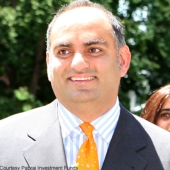
Mohnish Pabrai


wealthymatters.com

Mohnish Pabrai is an Indian-American businessman and deep value investor.He is the managing partner of the Pabrai Investment Funds, which he founded in 1999.He is also a member of the Young President’s Organization (YPO) and a charter member of The Indus Entrepreneurs (TIE).

Monhnish Pabrai first trained as a computer engineer. He then spent nearly two decades in the tech field.In 1990, he quit his job working as an engineer for Tellabs in Chicago and abandoned his master’s thesis at the Illinois Institute of Technology to launch TransTech, an IT consulting and systems integration company, which he funded with $30,000 from his retirement account and $70,000 from credit cards.His father encouraged him in the endeavour,saying that it was the right thing to do as staying at Tellabs and following the staid boring corporate path was high risk. Starting a business on the other hand was low risk, could give high returns and high adventure. As Monaish was single at the time there were few complications and in the worst case, he would lose everything ,which wasn’t much anyway,and could declare personal bankruptcy and start over. By 1999, Transtech, which had grown to 200 employees and $30 million in revenues, held no thrill. So he sold it. And during the tech boom,he started another company, internet incubator Digital Disrupters, which had a very painful and swift demise due the tightening of capital markets .In 2000, he sold TransTech to Kurt Salmon Associates.During late 1999, with nine other investors contributing $100,000 each,Mohnish started Pabrai Funds with $1,000,000 in assets. Pabrai Funds was modelled on the original “Buffett Partnership.” Read more of this post

Confusing Uncertainity With Risk


wealthymatters.comHere is an extract  from the article ‘ Investors will miss out if they confuse uncertainity with risk ‘ by Whitney Tilson published in the Financial Times on 16 Feb 2008.I think confusing uncertainity with risk is precisely what happened pre-budget in India this year. And this confusion is something that happens to a greater or lesser extent every year before the budget.The same thing happens before the final decision is taken on any government policy. So if a  stock investor remembers that there is a difference between uncertainity and risk he/she can sometimes buy shares cheap.Risk means the chance of a loss of capital. Uncertainty is the range of different outcomes. So a stock may have high uncertainty but may not be risky, if no one knows what will happen but the worst case scenario would not results in a huge loss.

“Dealing with uncertainty is always a key challenge for investors. But dealing with uncertainty doesn’t mean avoiding it – on the contrary, it is often fuzziness about a company’s future that creates the type of opportunity bargain-hunting investors cherish.Wall Street in the main hates uncertainty, which manifests itself in depressed share prices of companies whose prospects lack “visibility.” But where the market can err is in confusing uncertainty with risk. Just because a company’s future is highly uncertain doesn’t mean an investment in it is risky. In fact, some of the best potential investments are highly uncertain, but have little risk of permanent capital loss. As hedge-fund manager Mohnish Pabrai describes it in his book, The Dhandho Investor: “Heads, I win; tails, I don’t lose much.” Read more of this post

6 Investment Rules


wealthymatters.comThe secret to doing well in stocks over the long term is to avoid making big mistakes rather than being spectacularly right a few times in one’s career.After all it just takes just one big enough mistake to wipe away all the gains of the previous years.The following checklist is to help avoid making major mistakes.

1. Avoid following the crowd.
Avoid the hottest stocks in the hottest sectors, which are invariably priced high.It’s far safer and more profitable to invest in stocks of companies that are either well-known but currently out of favour or not tracked at all by analysts often simply because they are too small to be of interest to institutional investors.

 2. Look for consistently positive cash flow and beware of debt.
Share holders make money through dividends.The company first needs to throw off cash through its operations to be in a position to reward shareholders consistently.Debt reduces the surplus available for share holders.Excessive debt might kill a company in bad times.

 3. Avoid serial acquirers and if necessary buy stocks of good companies after big acquisitions.
Making many small acquisitions or one big one are both fraught with peril, yet some managements insist on engaging in such behaviour regularly. They often fritter away the resources of their companies and shareholders in this way.If you must buy a company that has just made an acquisition buy after the deal , when the share price has dropped , not in the frenzy before the deal. Read more of this post

The Perfect Business


wealthymatters.com

The best and easiest way to make money either as a businessperson or an investor is to get hold of an as near to perfect business as possible.The best businesses have the following features:

  1. High profitability. If the business provides customers a product or service they need or want very much, and only this business can provide it, and there are few substitutes available then this firm can charge a premium price far above the costs it incurs.
  2. High returns on capital. A business with high margins ceases to be very attractive if it is very capital intensive and requires massive amounts of capital to launch and/or remain in business. The greatest businesses require little or no money to start, can grow without major additions of capital, and do not require much maintenance cap ex.
  3. An enormous moat. To ensure high margins and return on capital  in the future it’s critical for a business to have major competitive advantages that are unlikely to dissipate over time. The key here is lack of change .Rapid change as in the hi- tech sector,benefits consumers but is very bad for investors. To quote Warren Buffett, “We see change as the enemy of investments… so we look for absence of change. We don’t like to lose money. Capitalism is pretty brutal. We look for mundane products that everyone needs…. I guarantee that CokeWrigley’s , and Gillette will dominate. The Internet won’t change what brands people like.”
  4. Profitable reinvestment opportunities.  The greatest businesses can reinvest their robust free cash flows back into the business at equally high rates of return on capital. Consider this: Warren Buffett has often lamented the fact that See’s Candies has never been able to expand much beyond its historical West Coast markets. It’s a fabulous company and was one of his best acquisitions ever, but the inability to reinvest its free cash flows back into growing its operations makes it an inferior business to, say, Wrigley, which has been able to grow globally over the years. Read more of this post

Gandhiji on Wealth


wealthymatters.com

“It is my conviction that it is possible to acquire riches without consciously doing wrong. For example I may light on a gold mine in my one acre of land. But I accept the proposition that it is better not to desire wealth than to acquire it, and become its trustee. I gave up my own long ago, which should be proof enough of what I would like others to do. But what am I to advise those who are already wealthy or who would not shed the desire for wealth? I can only say to them that they should use their wealth for service.

It is true that generally the rich spend more on themselves than they need. But this can be avoided. Jamnalalji spent far less on himself than men of his own economic status and even than many middle-class men. I have come across innumerable rich persons who are stingy on themselves. For some it is a part of their nature to spend next to nothing on themselves, and they do not think that they acquire merit in so doing.

 The same applies to the sons of the wealthy. Personally, I do not believe in inherited riches. The well-to-do should educate and bring up their children so that they may learn how to be independent. The tragedy is that they do not do so. Their children do get some education, they even recite verses in praise of poverty, but they have no compunction about helping themselves to parental wealth. That being so, I exercise my common sense and advise what is practicable.

Read more of this post