Kotak Jifi Is Here,Grab Yours
March 23, 2014 2 Comments
 I’m just back from the Kotak Jifi launch with Chetan Bhagat.It was a rocking party at a great venue:Cafe Zoe, with great food and better drinks. Well Done IndiBlogger Team!It was the best IndiBlogger meet ever!
Now onward to serious business. And mind you,I’m sober,so the recommendation is not due to alcohol induced mellowing.
Checking accounts for individuals are common in the US,not so in India. Kotak Jifi is a checking/current account for individuals.And more importantly,it is a zero-balance-account.So like most current accounts,this one too pays no interest on your money but unlike others, you are not obliged to park even a single paisa for a single day in this account.So this is a great bank account for transacting business.And in doing so you will find the internationally accepted Platinum Debit card with a 2 lakh limit per day,handy.Any balance over Rs 25,000 you park in this account, however temporarily, is automatically swept into fixed deposits and earns you 8%interest pa .Better yet,you can check your balance in this account via Twitter.This is bound to come in handy when you are abroad and telcom services seem to cost a bomb,ATM balance queries are charged but Wi-fi hotspots are common.
To get your exclusive invite to the Kotak Jifi Circle,click on this Link
And BTW if you are wondering….this account has all the services offered by other bank accounts.
As an aside, seeing Chetan Bhagat upfront,was something of a surprise.I would have expected more of a ‘celebrity type’ or ‘power persona’.He however turned out to be something of a’guy next door’.Perhaps it is this very groundedness and the ability to speak to ordinary people at their level that makes him the success he is.


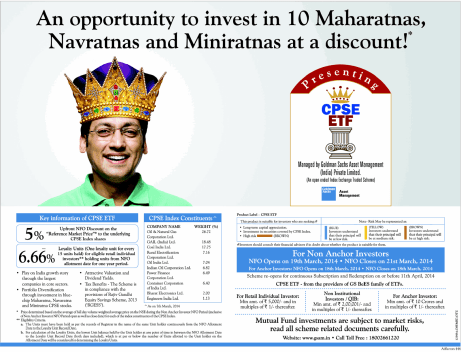 Almost two years after it was first mooted, the specialised exchange-traded fund (ETF) for public sector stocks is finally getting off the ground. The government has selected Goldman Sachs Mutual Fund to run this fund, which will be called the Central Public Sector Enterprises (CPSE) ETF. ETFs are generally based on an equity index and replicate that index in their portfolio so that investors can invest in it easily.






 wealthymatters